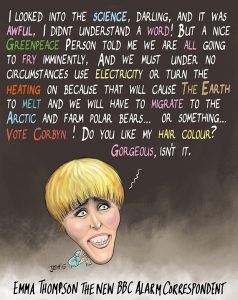
 Storbritannias BBC har nylig fått tilsendt en omfattende klage på manglende objektivitet i sin klimajournalistikk. BBC er på samme måte som vårt hjemlige NRK forpliktet til å holde seg med en saklig og objektiv journalistikk, hvor alle parter skal få komme til orde.
Men begge disse statseide kanalene har isteden satt ytringsfrihet-en til side og bedrevet omfattende ensretting, hvor alle lovpålagte krav om saklighet, allsidighet og objektivitet er fullstendig ignorert.
En innledning med 14 konkrete punkter
Klagens tittel er i seg selv en munnfull, og lyder som følger: «Complaint of BBC prejudice in covering of climate change and warning of potential judicial review.»
Følgende personer står som underskrivere: Piers Corbyn, Richard Courtney, David T C Davies MP, Philip Foster, Roger Helmer MEP, Alex Henney, Paul Homewood, Lord Christopher Monckton of Brenchley, John Whitfield, Rupert Wyndham.
Her er det verdt å merke seg at BBC har et «Charter» og NRK har vedtekter som skal sikre at alle synspunkter i en sak kommer fram og at saklighet og objektivitet skal stå i høysetet. Medieeiere og redaksjoner har redaksjonell frihet til å velge en bestemt redaksjonell linje i en sak som er viktig, men denne friheten gjelder hverken for BBC eller NRK. Derfor kan ikke BBC og NRK gjøre som kollegaene The Guardian og Aftenposten som har en klimadekning som er ensporet alarmistisk, usaklig med tildels religiøst preg, og med en særdeles svak naturvitenskapelig forankring – til fortrengsel for objektivitet og saklighet. Men begge gjør det likevel.
Vi gjengir her BBC-klagens innledning, uten ytterligere kommentarer:
We enclose a complaint from all of us about persistent partiality in the BBC’s coverage of climate change. From the outset, on the climate question the BBC has tended to reflect only one view – that of the climate science establishment who are promoting a view that man is causing significant global warming (which, with the plateau in temperature, has morphed into “climate change”, a term that is used to cover a wide range of weather events). It has excluded those whose opinions, though based on factual science and sound economics and logic, differ from the “official” position. The BBC has often promoted tendentious and scientifically illiterate but “politically-correct” opinions and has kept from the airwaves those who do not agree.
We and many others alongside us have come to the opinion that the BBC’s continuing bias on the climate question – its performance is too often like a scientifically illiterate, naïve, oft times emotive green activist organisation – is unacceptable and must now be brought to an end. In future, both sides in the climate debate must be fairly heard, whether BBC staff like it or not.
Accordingly, we make the following recommendations to ensure that in future the BBC adheres to its obligation of impartiality and of accuracy in its climate-change coverage –
1) To ensure balance, and to give senior executives at the BBC a proper understanding of the sceptical viewpoint, the Trust should arrange for Lord Monckton to co-ordinate a team of leading sceptical scientists and economists to give a day-long, high-level briefing for senior BBC executives in broadly the same job descriptions as those who attended the secret briefing in 2006. This meeting is a minimum requirement to restore even-handedness at the BBC on the climate issue by ensuring that all relevant senior BBC personnel are obliged, whether they like it or not, to respect the principle of natural justice as well as the BBC’s obligation of impartiality by hearing the other side of the case.
2) The Trust should circulate to all executives and programme-makers in the field, and to all news and current affairs personnel, a document to be prepared by us in consultation with leading scientists that will summarize in a dozen pages the sceptical side of the case. This is a minimum requirement to ensure that the BBC and all its senior personnel are made aware of the considerable body of scientific evidence, data and papers that cast doubt upon its chosen position in the climate debate, so that the BBC can find its way easily to these sources in future.
3) Prominent “sceptical” journalists and climate scientists from the UK and US should be invited to put together a series of TV programmes giving the other side of the story on the climate. The programmes should be broadcast on the BBC during prime time. This series is a minimum requirement if balance is to be restored to the BBC’s climate-science coverage as the law requires.
4) The Trust should require that the section on “Consensus” in the impartiality topic under the BBC’s Guidelines should be rewritten or deleted. The BBC should in future be obliged to adhere strictly to its editorial standards, particularly the obligation of impartiality, and should not be permitted to avoid doing so by distorting the usual meaning of language by “calibrating” its supposed impartiality. The BBC should be required to reflect all opinions, including those with which it disagrees, and to give a right of reply to sceptical scientists. Journalists’ own personal opinions should not be permitted to colour their reportage. This is a necessary minimum step to ensure that neither the Trust nor the BBC can in future evade the obligation of impartiality by rewriting the Guidelines to suit their political prejudices.
5) The BBC should employ at least one climate sceptic in a senior journalistic role. David Bellamy, for instance, was taken off the air after he let slip that he was querying the extent of Man’s influence on climate. The deliberate exclusion by the BBC of all sceptics from its environment and climate reporting team is unacceptable.
6) Messrs. Renouf, Harrabin, Shukman and Heap should be reassigned from climate programmes on grounds of prejudice.
7) The BBC should adopt a nuanced, mature, unprejudiced, non-alarmist approach to the climate question. It should accept that there is a growing body of research in the scientific literature that questions the extent of man’s likely future influence on climate, that there is near-unanimity in the economic journals that it would be cheaper to adapt to global warming later than to attempt to mitigate it now; and that, particularly on climate sensitivity, opinion in the literature is far less one-sided than the BBC has thus far let on.
8) The BBC should abide by the Singapore Statement on Scientific Integrity in selecting scientists to appear on programmes.
9) The BBC should eschew basing its stories on predictions whose medium-term versions have already proven to be wild exaggerations. Instead, it should base its stories on what is actually happening in the climate.
10) The Trust should forbid the BBC to ascribe individual extreme-weather events to manmade global warming, and should forbid it to allow scientists to make such allegations, unless scientists willing to support the IPCC’s position that individual extreme-weather events cannot be ascribed to global warming are also interviewed.
11) The Trust should require the BBC to disclose in each programme about the climate its own and its journalists’ financial or other conflicts of interest, such as the fraction of the journalistic and editorial pension funds that are invested in “green” energy.
12) The BBC’s website should contain regular updates on the actual climate data – e.g. practically no global warming over the past decade or two; Antarctic ice extent at or near its satellite-era maximum for many recent years; hurricane activity at or near a satellite-era low; land area under drought declining for 30 years.
13) The BBC should be required to provide meaningful rights of reply to well qualified persons who dissent from the agenda it now promotes.
14) The BBC should forthwith take active steps to give no further ground for the perception that it is institutionally wedded to manmade climate change as though it were canonical truth.
Our complaint should not have had to be made at all. It is an indication of the depth to which the BBC and the Trust have sunk that we have had to make it, and to put forward recommendations to ensure that the BBC’s bias on climate is ended.
The BBC has failed so far to respond to Henney’s complaint dated 15/2/2016 (and is just repeating the flawed programme by Attenborough in Australia). We should be grateful if the BBC would reply within 60 working days, failing which the matter will pass to the Trust for determination. To comply with the Civil Procedure Rules, we make it clear at the outset that unless our complaint is responded to in what we regard as a satisfactory and timely fashion, we may have to apply for judicial review of either the BBC or the Trust or both. However, we should rather resolve this matter without recourse to the courts. We hope, therefore, that the BBC and the Trust will take our complaint seriously and give us a reasonably prompt, full and considered reply. We would be pleased to discuss the matters with you.

