 Vi har temperaturdata for februar fra UAH ved Dr. Spencer. Globalt satellittmålt temperaturavvik fra gjennomsnittlig temperatur (TLT) for februar viser med +0,20 o C et lite fall fra forrige måned. Pausen eller opphøret i signifikant global oppvarming som er beskrevet i FNs klimapanels siste hovedrapport fra 2014 er fortsatt reell og den pågående La Niña fortsetter å kjøle oppover i troposfæren. For mer informasjon om værfenomenet El Niño som hadde sin topp i februar 2016, se Klimanytt120. TLT-dataene er fra lavere troposfære.
 UAH Data
UAH står for «University of Alabama Huntsville», som publiserer månedlig avvik fra et gjennomsnitt for perioden 1981-2010. Februar 2018 har med (+0,20 o C) gitt oss et lite fall fra verdien (+0,26 o C) forrige mnd. Nordlige halvkule er tydelig kjøligere med 0,24 o C nå, fra 0,46 o C forrige mnd. Sydlige halvkule (0,15 o C) og tropene (0,03 o C) har ubetydelige endringer fra forrige mnd. Temperaturdataene er hentet fra de nederste 8 kilometer av atmosfæren. En detaljert forklaring på dataene i figuren er her.
UAH bruker data fra 3 satellitter (NOAA-18, NOAA-19, og den nyere Metop-B). Metop-B satellitten vedlikeholder sin egen bane slik at det for denne satellitten er behov for færre korrigeringer for en gradvis degradert bane.
En fortolkning av temperaturpausen siden år 2000
Nicola Scafetta har med flere kolleger publisert forskning som viser at varmetoppen i 2015-16 ikke kan knyttes til menneskeskapte drivere. Ved å fjerne ENSO-signalet ser man at observert temperaturutvikling skiller seg stadig tydeligere fra IPCC-leirens klimamodeller. Vi gjengir sammendraget her (vår understrekning):
The period from 2000 to 2016 shows a modest warming trend that the advocates of the anthropogenic global warming theory have labeled as the «pause» or “hiatus.” These labels were chosen to indicate that the observed temperature standstill period results from an unforced internal fluctuation of the climate (e.g. by heat uptake of the deep ocean) that the computer climate models are claimed to occasionally reproduce without contradicting the anthropogenic global warming theory (AGWT) paradigm. In part 1 of this work, it was shown that the statistical analysis rejects such labels with a 95% confidence because the standstill period has lasted more than the 15 year period limit provided by the AGWT advocates themselves. Anyhow, the strong warming peak observed in 2015-2016, the «hottest year on record,» gave the impression that the temperature standstill stopped in 2014. Herein, the authors show that such a temperature peak is unrelated to anthropogenic forcing: it simply emerged from the natural fast fluctuations of the climate associated to the El Niño–Southern Oscillation (ENSO) phenomenon. By removing the ENSO signature, the authors show that the temperature trend from 2000 to 2016 clearly diverges from the general circulation model (GCM) simulations. Thus, the GCMs models used to support the AGWT are very likely flawed. By contrast, the semi-empirical climate models proposed in 2011 and 2013 by Scafetta, which are based on a specific set of natural climatic oscillations believed to be astronomically induced plus a significantly reduced anthropogenic contribution, agree far better with the latest observations.
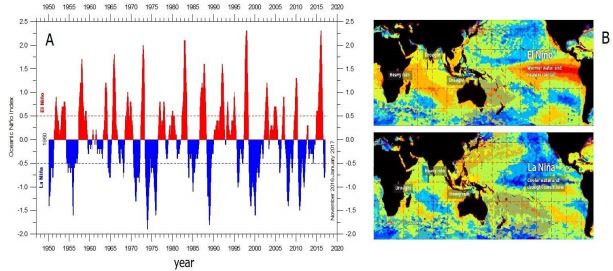
Første del av denne forskningen er publisert her. Figuren under fra forskningsrapporten viser hvordan ENSO-signalet fra El Niño og La Niña varmer og kjøler klimaet. Den rollen som er igjen til våre CO2-utslipp blir ubetydelig.


I mars og april 2017 skrev Aaslid: “Året 2016 var (statistisk insignifikant) 0.02 o C varmere enn 1998 med sin +0.48 o C. Estimatet viser at 2016 måtte vært 0.10 o C varmere enn 1998 for å være signifikant forskjellig med et 95% konfidensintervall.”
Om man går de samme 18 år tilbake vil man se at temperaturen har økt SIGNIFIKANT (0.27 C varmere altså med god margin). Går man 30 år tilbake i tid – som jo er mer relevant i klimasammenheng er vi også innenfor det Aaslid kaller SIGNIFIKANT økning av temperaturen. Kilde er samme tallene det henvises til i artikkelen
Noen har sagt at med dumskap skal verden styres.
Med klima er dumskap satt i system til de grader at vettuge mennesker blir skremt basert på hypotetiske påstander om CO2 (ikke giftig gass som livet vårt er avhengig av) som «farlig» drivhusgass. Før bevis for slike påstander!
Har selv ennå ikke sett et eneste bevis for at dette er tilfellet, og da har jeg trålet gjennom den hyppig refererte «konsensus»litteraturen uten å komme noe som helst nærmere svaret.
Skal vi da kunne stole på politikere når fundamentet er til de grader uklart? Selvsagt ikke! Vi må stole på oss selv, såkalt sunn fornuft er avgjørende.
Politikere bør helst lese seg opp såpass at de vet at det ikke er konsensus omkring disse spørsmålene. Kanskje vi da kunne unngå det vanvittige pengesløseriet omkring CO2 fangst som heller burde vært brukt på de som trenger støtte og til ren vitenskapelig forskning uten bias for å sikre et godt levemiljø for fattig og rik.
Cicero er for meg ikke et kompetansesenter for klimavitenskap. Kun hr. Samset prøver a late som dette er tilfellet. Faktum er at Cicero består såvidt jeg kunne se av en helt fersk gelog, noen få metorologer og en mengde «nedstrøms» forskere som tar det for gitt at vi har en klimakrise. Ingen stiller spørsmål om dette faktisk er tilfelle.
Hvor er det blitt av den gamle sunne skepsis hos disse menneskene?
Du er vel klar over at Ciceros formålsparagraf forutsetter at mennesket har skapt en klimakrise, og at denne stiftelsen for bestillingsforskning i de 15-16 første årene holdt seg med navnet «Institutt for klimapolitikk»?
De ansatte der er mer enn gjennomsnittlig godt utrustet med skepsis – mer eller mindre sunn skepsis mot all kritikk av det de driver med.
Klimapolitikk.
Når Beck publiserer «forskning» er det i følge Aaslid usaklig å påpeke at tidsskriftet «forskningen» ble publisert i jobber for å fremme fossil energi. Hvorfor slike doble standarder Aaslid? Er det for vanskelig å ikke skifte mening annenhver dag?
Men hva er egentlig så spesielt med fossil energi, i forhold til annen energi. Når hele regnestykket er gjort opp er det ingen forskjell. Fossil energi har også til syvende og sist sitt opphav i solenergien. Verden er nå klar for et paradigmeskifte i tankegang. Mange må nå rense sine forestillinger om at fossil energi er spesielt «skitten».
«Når hele regnestykket er gjort opp er det ingen forskjell.» Med fossil energi tar det flere hundre millioner år før regnestykket går opp. For ved tar det rundt 100 år. For sol, vind og vannkraft går regnestykket opp umiddelbart. Det gjør en stor forskjell.
«Verden er nå klar for et paradigmeskifte i tankegang. Mange må nå rense sine forestillinger om at fossil energi er spesielt “skitten”.» Eh, det er vel omvendt. Fossil energi har blitt omfavnet i flere hundre år. Nå som vi kan bedre er det på tide å forandre på det.
Hvor lenge har fossil energi og co2 vært «skittent»? 30 år? Hverken carbon eller co2 er «skittent» . Det ene er et grunnstoff, det andre er en atmosfæregass. Begge deler er livsviktige og helt rene bestanddeler i vår eksistens. Første skritt i paradigmeskiftet kan være å fjerne forakten disse 2 komponentene omtales med.
Prisen for, av ideologiske grunner, å avholde seg fra å benytte fossil energi er at biologisk materiale tvinges til å erstatte det fossile. Konsekvensen av en slik feilvurdering vil være katastrofale, med svekket grunnlag for fotosyntese (oksygenproduksjon) og tap av matproduksjon i stor skala. Dette har allerede begynt å skje. Av denne og flere grunner må, derfor paradigmeskiftet komme. Og det kommer! Men det betyr ikke at satsingene på vannkraft, solkraft og vindkraft, samt atomkraft, blir uaktuelle: Nei tvertimot! Vi trenger flere alternative energikilder for å opprettholde verdige liv og forsvarlig økonomi. Alle energialternativer må imidlertid stå på egne ben.
«For sol, vind og vannkraft går regnestykket opp umiddelbart.»
I sin rene naturlige form ja, men ikke når det gjelder våre aktuelle ekspansive tekniske løsninger og vi i den sammenhengen tar med naturinngrep, ressursbruk og langsiktige konsekvenser for fugler, fisk og dyr, mennesker, landskap og miljø, Da utlignes fordelene svært fort. Et menneskeskapt solcellelandskap, eller et menneskapt vindturbinlandskap, kan ende som skraphauglandskap og et rent helvete. Dette er derfor metoder som må benyttes med varsomhet, kunnskap og kløkt. Subsidietrykket som er der i dag, kan medføre at det ut fra kortsiktige økonomiske interesser, men kjørt fram med alle mulige miljøargumenter, bygges gigantomaniske «alternative» energianlegg med enorm framtidig skadevirkning, anlegg som aldri skulle ha sett dagens lys. Tilgang på ren fossil energi kan heldigvis forhindre dette.
En ting til: Anti-CO2 bevegelsen må ilegges en stor del av ansvaret for den globale plastforsøplingen i hav og vassdrag. Anti-CO2 propagandaen har bidratt til å hindre de rasjonelle og fornuftlige løsningene for å bli kvitt plastavfallet. I mange land er det enorme åser og fjell av plastavfall som forvitrer og avrenner til havet som mikroplast. Den rasjonelle og fornuftige løsningen ville være å omdanne plasten til energi eller energibærer, carbon og CO2 ved forbrenning eller pyrolyse, samt gjenvinning der det er mulig.
Men da må man ikke ha skrekk for CO2. Enda en grunn til paradigmeskiftet!
Det Aaslid skriver om temperaturen i 1998 vs 2016 er korrekt. Sjekk temperaturseriene. So, what’s the fuzz?
Har du motstridende fakta så kom med tall og tidsangivelser samt en forklaring så vi kan etterprøve dine påstander.
Dette var en kommentar til Olavsen ovenfor. Fingrene glipper litt på en iPad.
Om du leser innlegget mitt…
Aaslid forteller altså hva som skal til for at en økning i temperaturen skal kunne defineres som signifikant. Økningen mellom 1998 og 2016 viste seg ikke å være signifikant (forresten to el-nino-år). Det er man enige om. Men stort sett alle andre tidsperioder viser en klar signifikant økning i følge Aaslids definisjon. Spesielt i perioden Aaslid mener at det ikke har vært temperaturøkning i det hele tatt. Så Aaslid kommer hver eneste med en påstand som er riv ruskende feil etter hans egen definisjon.
Og kilden? Som sagt den Aaslid selv henviser til. Fritt tilgjengelig. Bruk litt kalkulasjoner i Google eller Microsoft sine kontorstøtte-applikasjoner.
Olavsen, din kommentar må være bygd på statistikk av Mannisk kvalitet. Se bekreftelsen på at min tekst er korrekt, i kommentar lengre ned fra Esilex Montagrius.
Aaslid. Se mitt svar til ham med pseudonymet. Kilden og definisjonen er dine egne.
Utfordringen er jo ikke om temperaturen øker eller ikke, men om det er mennesker eller naturen selv som påvirker utviklingen. Selvsagt har vi en viss påvirkning, men naturen selv har bidratt langt mer til naturlige temperatursvingninger, langt større enn det vi nå opplever. Siden det ikke finnes fnugg av bevis for menneskets signifikante påvirkning på temperatur annet enn noen korrelasjoner som kan tilskrives en haug med forskjellige årsaker, er det helt utrolig at så mange henger seg ukritisk på hypotetiske påstander om slike sammenhenger. Man kan jo lure på hvorfor ellers oppegående mennesker lar seg dupere med «vitenskap» som ikke lar seg verifisere. Hvorfor er det slik?
En helt annen sak er all diskusjonen rundt biodiesel,som skal komme fra fornybare kilder, les regnskog eller palmer. Det som aldri fremkommer er at enhver form for utnyttelse av slike kilder ikke tar i betraktning at en stor del av disse kildene går i forråtnelse og mye av materialet blir til, ja til kull og bevares i undergrunnen. Gitt at dette har noen betydning er det et paradoks at det er bedre å blåse alle disse trærne til himmels ved forbrenning nå enn å la store deler av dem heller gå inn i den naturlige syklusen som bevarer carbon i undergrunnen. Synspunkter?
Nå Geir er vi vel drøyt halvveis (fra +0,85 på topp ned til +0,2 i februar)? Så la oss håpe på at temperatur-avviket fortsetter å falle med minst 0,4 grader til og deretter stabiliserer seg rundt eller litt under null-streket igjen fremover. Da kan vi vel avblåse hele CO2 greia? Det nærmeste året vil bli spennende. Skulle vært nydelig, hvis det viser seg at drivhuseffekten er grovt overestimert for jeg har vel veldig liten tro på at verden noensinne vil klare å reversere utslippene. Jeg krysser fingrene!
Ja det er vel svært mange rapporter og analyser som viser klare tegn på at drivhuseffekten er grovt overestimert Karsten. I alle fall hvor mye den kommer til å øke ved økt atmosfærisk CO2. Dessuten kan ikke den påståtte oppvarmingen stoppes, om man benytter IPCC tall og prognoser, da mange store land har fått utsettelse for sine økte utslipp frem til 2030.
Jo forresten, man kan lage et nytt tippingpunkt. Det er forøvrig ikke vitenskap som avgjør hva kloden tåler, men politikk. Man kan derfor lett konstruere nye verdier for verdens undergang.
Under en rettssak i Kalifornia 2006/2007, angående maksimalt forbruk og utslipp fra bilparken, legger John Christy frem beregninger for hva dette vil utgjøre for den påståtte menneskeskapte temperaturstigningen. Han legger også frem tall for hvilken reduksjon det vil medføre om hele USA innfører denne lov, og han gjør denne beregning med IPCC sine egne tall, som han selvfølgelig mener gir alt for stor effekt. Men selv med IPCC sine tall vil innføring av denne lov, i hele USA medføre så godt som ingen reduksjon av påstått temperatur i 2100. Han legger sogar frem beregning hvor USA opphører å eksistere, USA får altså totalt 0 utslipp frem til 2100. Selv dette cenario vil kun medføre en tiendels grad, dette gjøres med IPCC sine beregninger som IPCC selv i ettertid av 2007 har justert ned.
I rettsdokumentet fra den gang finnes disse tall. Og IPPC ved Hansen kom ikke med innsigelser til konklusjonene i dette rettsdokument. Hvorfor, fordi beregningen Christy la frem var uangripelig, han benyttet jo IPCC’s egne tall og beregninger.
Det var forøvrig på bakgrunn av denne rettssak norske myndigheter dengang (04-05-06-07) anbefalte befolkningen å kjøpe dieselbiler med lavt CO2 utslipp. Noe den norske befolkning gjorde i stort monn. Dette skal den samme befolkning straffes for i ettertid, i form av egne dieselavgifter. Bor du i Oslo, og MDG får det som de vil, risikerer du og ikke ha lov til å benytte bilen din til tider, om den går på diesel.
Så jeg er helt enig, vi får krysse fingrene. Galskapen må stoppes. Verden har helt andre viktige problemer menneskeheten må få orden på. Tenker spesielt på alle undertrykte.
Jeg ser ingen grunn til å «avblåse hele CO2-greia», i og med at det etter 500 millioner år med nedgang i atmosfærisk CO2 nå er mangel på denne gassen i atmosfæren. Man trenger tvertimot å stimulere til økt resirkulasjon av CO2 tilbake til atmosfæren, og kan samtidig benytte anledningen til å gi våre politikere et grunnkurs i fotosyntesen.
Når det gjelder spørsmålet om drivhuseffekten (for Co2) er overdrevet, så minner jeg om at våre utslipp økte fra 1950 til 1977, mens vi i samme tidsrom opplevde at global temperatur falt med ca 0,3 grader Celsius.
Denne observasjonen over 27 år viser enten at den CO2-drevne hypotesen er falsifisert, eller at CO2 tilført atmosfæren vekselvis virker oppvarmende og nedkjølende. Det siste har jeg ingen tiltro til, og jeg ser det heller ikke som en anbefalt løsning å jukstere ned temperaturene for nedkjølingsperioden 1950-77 slik at man slipper å ta stilling til denne falsifiseringen.
«etter 500 millioner år med nedgang i atmosfærisk CO2 nå er mangel på denne gassen i atmosfæren.»
Det er ikke mangel paa CO2 i atmosfaeren.
«Denne observasjonen over 27 år viser enten at den CO2-drevne hypotesen er falsifisert, eller at CO2 tilført atmosfæren vekselvis virker oppvarmende og nedkjølende.»
Nei, den viser at naturlige variasjoner spiller en rolle. Derimot kan INGEN naturlige variasjoner forklare store deler av den globale oppvarmingen siste 100-150 aar (sola staar for opptil 10%, men hvor kommer resten fra?). I foelge Lindzen, som du svaert ofte refererer til, gir en dobling av CO2 en temperaturoekning paa 1°C (uten aa ta hensyn til feedback). Akkurat det samme som IPCC, og alle andre, har regnet ut.